Hi Chasers,
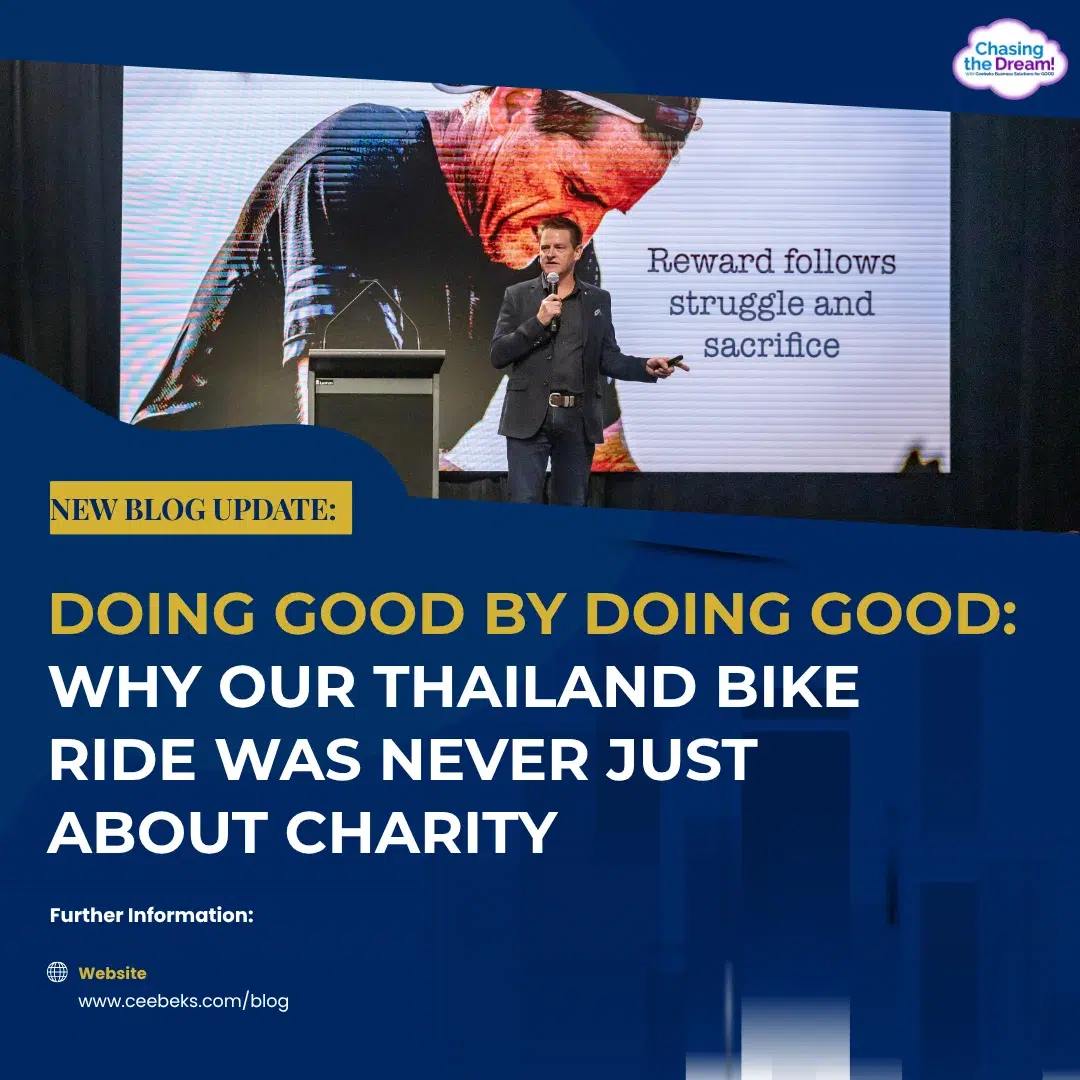
A few years ago, Peter Baines OAM—the founder of Hands Across the Water—wrote a book titled Doing Good by Doing Good. Its subtitle captured an idea that completely challenged much of the conventional thinking around Corporate Social Responsibility:
“Why Creating Shared Value is the Key to Powering Business Growth and Innovation.”
At the time, many assumed it was simply a catchy title. It wasn’t. It was the core philosophy upon which Peter built Hands Across the Water—and it’s the exact reason why our bike rides in Thailand were undertaken in the first place.
Today, more than twenty years later, this philosophy has proven to be an evidence-based business model that drives real commercial and personal growth.
Over those two decades, Hands Across the Water has weathered the Global Financial Crisis, political instability, natural disasters, changing donor behaviour, and a global pandemic. Like every organisation, we have faced periods of uncertainty that challenged our resilience. Yet throughout it all, Hands hasn’t simply survived.
It has grown.
Not because the team became better at fundraising, but because they became better at creating value. That distinction sits at the heart of everything we share with businesses today.
Asking the Wrong Question
For decades, philanthropy has been viewed through a simple equation: Build a profitable business, allocate part of those profits to community investment, and measure success by how much you gave away.
It sounds logical. It is also one of the reasons so many corporate giving programs disappear during difficult economic conditions. When philanthropy sits on the Profit and Loss Statement as an expense, it is managed like every other expense.
-
When budgets tighten, it is reduced.
-
When profits fall, it is questioned.
-
When shareholders demand efficiency, it becomes vulnerable.
The issue has never been generosity. The issue has always been the business model behind generosity. For years, businesses have been asking the wrong question.
Instead of asking, “How much should we give?” we should be asking, “How much value can we create?” Everything changes when you make that shift.
Hands Across the Water As the Evidence
People often ask how Hands Across the Water has been sustained for more than twenty years. They expect the answer to be a clever fundraising strategy, marketing, or donor acquisition.
The reality is much simpler. From the beginning, Peter and the team made one decision that has guided every program created:
Don’t ask, “How can people help Hands?” Ask, “How can Hands help people?”
Ironically, that is exactly why people continue to support Hands. Whether someone is a multinational corporation, a family-owned business, a small business owner, an individual participant, or an entire family joining one of the experiences, the first responsibility is to create value for them.
If that value is created well enough, the organisation thrives, the children and communities supported benefit, and those who offer support become stronger because of the experience. Everyone wins.
That is shared value.
It’s also why Hands Across the Water is more than just a charity—it is a living laboratory testing one simple hypothesis: Can creating value for others become the engine of sustainable organizational growth?
Shared Experiences Create Shared Value: Why We Ride
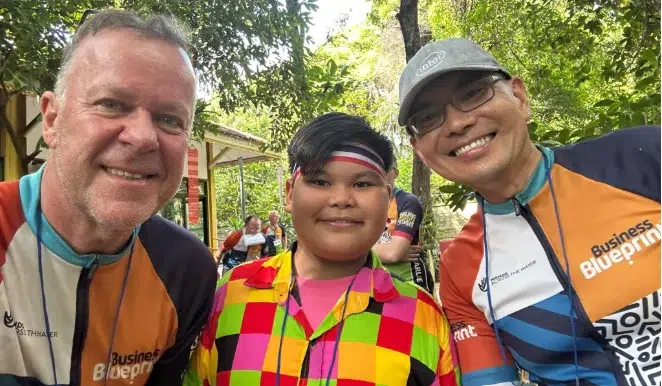
Nowhere has this principle been clearer than through the cycling experiences in Thailand. People often register believing they are riding to support a charity. That may explain why they sign up. It doesn’t explain why they come back.
Over days spent riding through rural Thailand, something remarkable happens:
-
Business owners find themselves riding beside CEOs they would never normally meet.
-
Parents reconnect with their children away from the distractions of everyday life.
-
Friends become lifelong friends.
-
Participants discover resilience they didn’t know they possessed, experiencing vulnerability that changes their perspective and leadership.
By the end of the journey, the charity has certainly benefited, but participants realize they have received far more than they have given. When someone returns home healthier, more resilient, with deeper relationships, new business connections, and a renewed perspective on life, they have received extraordinary value.
The charitable outcome becomes the consequence—not the sole motivation.
That is why rider retention remains exceptionally high. People don’t return simply because they are asked to support Hands Across the Water again; they return because the experience improved their own lives.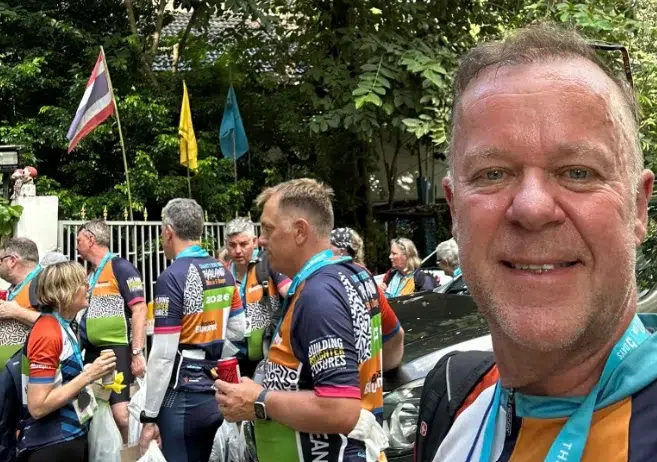
Applying the Principle to Business
Many organisations still separate commercial success from community impact; one belongs in the boardroom, the other belongs in Corporate Social Responsibility. That distinction has become outdated.
Today’s stakeholders want more:
-
Customers buy trust, authenticity, and purpose. They choose organisations whose values align with their own.
-
Employees want to know that their work contributes to something meaningful alongside salary and career progression.
Purpose has become a commercial advantage. Organisations that genuinely improve the lives of customers, employees, and communities create stronger emotional connections.
Those emotional connections translate into:
-
Higher customer retention
-
Greater brand advocacy
-
Lower staff turnover
-
Stronger workplace cultures
-
Higher productivity
-
Stronger financial performance
Doing good is no longer separate from doing business. It becomes one of the primary reasons business succeeds.
Measuring Impact Like Any Other Investment
One criticism often directed at Corporate Social Responsibility is that it is difficult to measure. Poorly designed phi
lanthropy is difficult to measure—well-designed shared value isn’t.
If creating social value contributes to commercial performance, then it should be measured exactly as any strategic investment would be:
| Commercial Outcomes | Shared Impact Metrics |
| Customer Retention & Lifetime Value | Long-term community sustainability |
| Employee Engagement & Turnover Rates | Capacity building & skill transfer |
| Brand Advocacy & Referral Rates | Direct social return on investment (SROI) |
| Brand Differentiation & Transaction Value | Measurable quality-of-life improvements |
The objective isn’t choosing between financial returns and social outcomes. The objective is demonstrating that each
strengthens the other. Once organisations begin measuring both, philanthropy stops looking like an expense and begins looking like one of the smartest investments they can make.
From Cost Centre to Growth Engine
Growth is the objective—growth in customers, trust, employee engagement, innovation, community impact, and enterprise value.
Growth becomes the engine, and philanthropy simply becomes one of the ways that engine is powered. When businesses create genuine value for customers, employees, and communities simultaneously, commercial growth follows naturally. That is not idealism—it is strategy.
After watching this philosophy unfold over two decades through Hands Across the Water, the lesson is clear for every business:
-
Customers remain loyal to organisations that improve their lives.
-
Employees stay where they find purpose.
-
Communities support organisations that invest in their success.
Growth becomes sustainable because everyone involved becomes better for having engaged with the organisation.
A New Definition of Success
The businesses that will define the next decade won’t necessarily be those that donate the most. They will be those that create the most value—for customers, employees, shareholders, suppliers, and communities.
Hands Across the Water has demonstrated that doing good and doing well are mutually reinforcing. The charity has ne
ver been sustained because people felt sorry for the children supported. It has grown because people discovered their own lives became richer through the experience of helping others.
The future belongs to organisations that stop asking how much they can afford to give back and instead ask a far more powerful question:
“How much value can we create together?”
Because when customers, employees, communities, and businesses all become stronger through the same strategy, growth is no longer something you chase.
It becomes something you create.

The 2026 Hands Across the Water Bike Ride took us across the north-eastern part of Thailand. Our spirits were boosted with the amazing Claire Baines (wife of Peter) joining us on the last day!
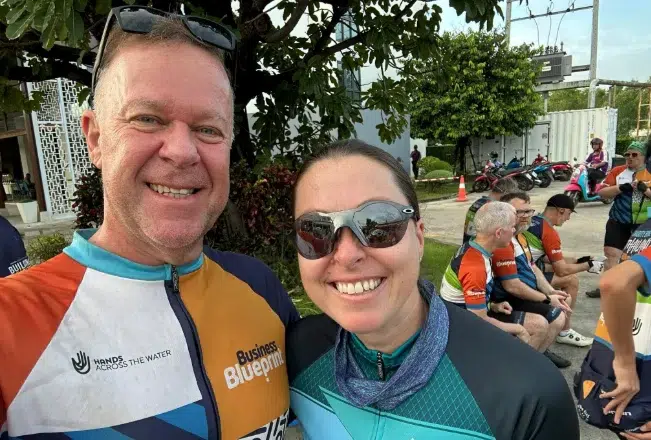
533 kms in 5 days, a challenge of the mind and body (especially the 4 km still incline near the dam wall),
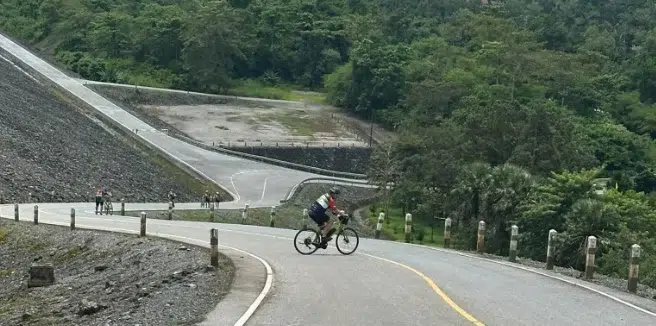
but one that all riders were up for, knowing that we were there for a specific purpose – raising funds to help vulnerable children receive the opportunity to chase their dreams! Something we often take for granted in Australia.
By simply being a customer of Ceebeks Business Solutions, you have indirectly supported this goal.
You are doing good by helping us do good
– thank you!
Read more of our daily blogs for valuable insights and stay up-to-date with the latest industry news – click here to access the full article on our blog page.